This website uses cookies to improve your experience. We'll assume you're ok with this, but you can opt-out if you wish. Read More
Client: Rock Crushing OEM and Mining Operations Customer (confidential)
Application: Jackshaft with Cantilevered Bearing Housing and Integrated Belt Tensioning System
Industry: Mining / Heavy Industrial
Deliverable: Jackshaft Assembly with Patented Tensioner and Proprietary Cantilevered Bearing Housing
The Situation
Belt-driven jackshafts on high-horsepower rock crushers have a maintenance problem that most mines have simply accepted as a cost of doing business.
On a standard slide-base jackshaft, the drive pulley sits between two outboard bearings. To change the belts, maintenance crews have to partially disassemble the outboard bearing housing, remove and replace the belts, reinstall the bearing, re-torque everything, and verify alignment before starting back up. It is a heavy, time-consuming job. With the motor, shaft, and hardware involved, a single belt change takes approximately eight hours of downtime.
At mines where downtime costs $25,000 or more per hour, that is a significant number — and most operations change those belts one to two times a year, on top of monthly re-tensioning cycles that take about three hours each.
Most mines have simply accepted this as the cost of doing business. ACS built a product that changes the calculation.
The Problem
The core issue was not just time. The standard bearing design created compounding maintenance problems:
- Disassembling and reinstalling an outboard bearing introduces alignment risk. If it goes back slightly off, it accelerates belt wear and bearing wear on the very equipment you just serviced.
- Monthly re-tensioning with a slide-base design requires moving thousands of pounds of motor and drive hardware using screws and hydraulic jacks — with no reliable way to confirm correct belt tension.
- Grease points and oil-level indicators are scattered across the assembly, requiring maintenance personnel to work in close proximity to running or recently-running belt drives to complete routine checks.
The standard solution in the industry addresses none of these. It just hands the problem to the maintenance team on a recurring basis.
The Product
ACS’s jackshaft with integrated belt tensioner is a purpose-built product — not a custom one-off, but a refined, patented design that ACS has been manufacturing and improving for over two decades. It was built specifically to solve this problem.
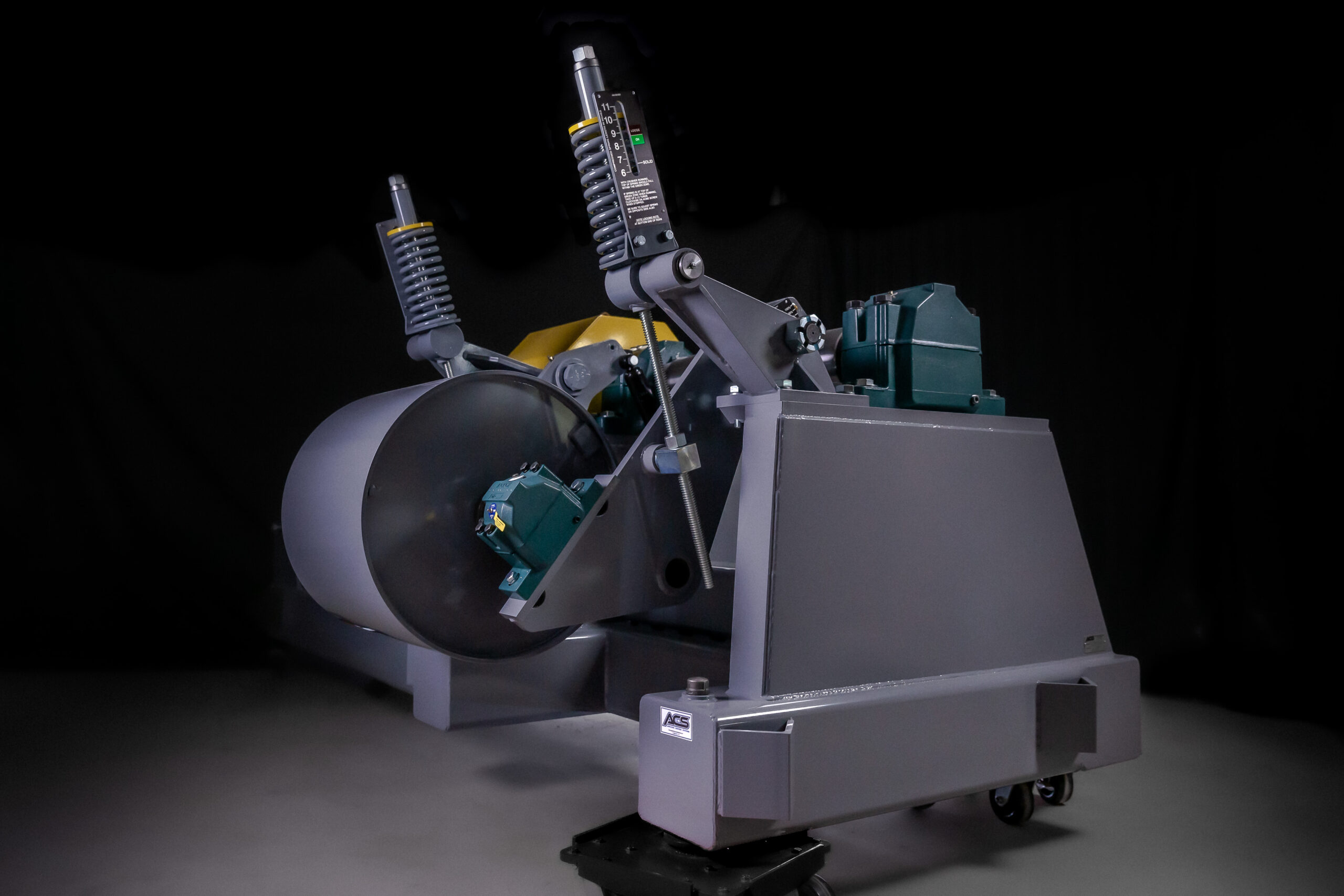
The centerpiece is a cantilevered bearing housing assembly that eliminates the outboard bearing entirely on the drive pulley side. The drive pulley extends beyond the main bearing housing on one end, fully exposed, with no bearing or housing on the outside face.
Belt changes no longer require bearing disassembly.
To change belts, the technician de-tensions the system, pulls the belts off the exposed drive pulley, swaps them, re-tensions to the gauge, and starts back up. No bearing to disassemble. No re-alignment required. What previously took eight hours now takes two to three hours — a 60% reduction in belt change time.
Monthly re-tensioning drops from three hours to thirty minutes.
The integrated tensioner uses an Acme thread screw with a calibrated gauge. The technician tensions to the indicator reading, confirms it visually, and walks away. No estimating, no hydraulic jacks, no sliding equipment.
Routine maintenance is performed from the safe side.
All grease ports are consolidated into a single service panel located away from the belt drive. Oil level is visible at a glance from the same location. Maintenance crews complete routine checks without getting near moving components.
The bearing housing assembly — approximately 12 to 13 inches in diameter with a six-inch shaft — is built as a rebuildable unit. When worn, it comes back to ACS for new bearings, seals, and gaskets, then goes back into service at a fraction of new cost. High-performing mine customers keep one spare on hand and rotate them on a scheduled rebuild cycle.
ACS holds a patent on the belt tensioner design. No other supplier in the market offers this combination of cantilevered bearing geometry and integrated automatic tensioning.
The Numbers
The financial case is straightforward once the variables are on the table:
- Standard jackshaft (slide-base): approximately $60,000–$70,000
- ACS jackshaft with cantilevered bearing housing and tensioner: approximately $150,000
- Belt change time saved per event: roughly 5 hours
- Monthly re-tensioning time saved: roughly 2.5 hours per cycle, 12 cycles per year
- Mine downtime cost: $25,000 or more per hour at many operations
- Equipment service life: ACS jackshafts have been running in the field for 25 years
The premium pays back on a single unplanned belt change event. For planned maintenance cycles, the math is just as clear. A mine running four crushers, each changing belts twice a year, recovers hundreds of hours of productive crusher time annually compared to operating standard slide-base jackshafts.
The Result
The ACS jackshaft has been deployed across rock crushing and pumping applications at multiple mining operations. Customers who understand the design sell it actively to their own customers. Those with the longest operating history run it without incident, rotate their bearing housing assemblies on a scheduled rebuild program, and have eliminated the alignment risk that routine belt maintenance used to introduce.
The machines are still running. Some have been in service for over two decades.
Why ACS
Most jackshaft suppliers sell to a catalog. ACS engineered around a real maintenance problem, patented the result, and has been refining it ever since.
What that looks like in practice:
- The cantilevered bearing design eliminates the disassembly step that makes standard belt changes an all-day job
- The integrated tensioner makes re-tensioning repeatable and measurable, not guesswork
- All service points are centralized away from the drive to protect the people doing the work
- The bearing housing is designed to be rebuilt and returned to service, not replaced
- The product has a 25-year track record in operating mines
The jackshaft is the product. The engineering is what makes it worth the price difference.
©2026 Appleton Control Systems
