This website uses cookies to improve your experience. We'll assume you're ok with this, but you can opt-out if you wish. Read More
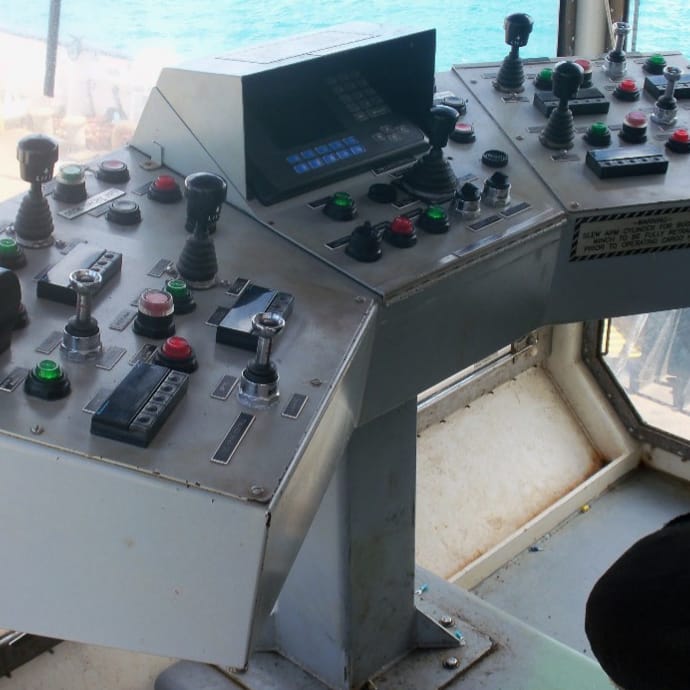
Ruggedized control and mechanical systems designed, built, and supported by engineers who developed their expertise in U.S. Navy defense programs and apply that same discipline to every project, regardless of market. From shipboard HVAC controls and UNREP systems to mining drive equipment and utility electrical control substations, the work is defined by technical accountability. Not volume.
Appleton Control Systems was founded in 1997 in Appleton, Wisconsin. For more than two decades, the company built a reputation in the marine defense industry, designing shipboard control systems, HVAC controllers, and UNREP equipment for U.S. Navy programs where qualification discipline and documentation rigor aren’t optional.
In 2021, Geoff White acquired ACS through his holding company, True Bear Engineering LLC, with a clear intent: build on that engineering foundation, expand into adjacent commercial markets, and grow the company the right way. By solving real problems for customers who need an engineering partner, not just a vendor.
Since the acquisition, ACS has continued to serve Navy and shipyard programs while expanding its presence in mining, industrial, and utility markets. The company has grown steadily since acquisition, and that growth is built on the same principles that defined the first 25 years: engineering credibility, compliance discipline, and the ability to deliver on technically demanding, low-volume work that larger suppliers aren’t built for.
The goal isn’t to become a large defense contractor. It’s to be the best engineering partner in this niche, and to keep building the team, the products, and the processes to support continued growth.
A lot of companies claim engineering capability. What matters is where that capability came from, what environments it has been tested in, and how it gets applied to every project. Not just the complex ones.

Most competitors specialize in one domain: electrical, mechanical, or controls. ACS engineers across all three, drawing on experience that spans naval shipboard systems, mobile equipment, hydraulics, mining machinery, forestry equipment, and industrial controls. That cross-industry breadth is how problems get solved that specialists miss, and how systems get built that treat the whole machine as the goal rather than just the component directly in scope.

Large contractors aren't interested in low-volume programs. Panel shops don't have the engineering judgment to define requirements. ACS works in the space between: high-complexity, low-volume work where you need a supplier who can think, not just build. That's the work ACS is structured for, and the work it does best.

ACS developed its engineering processes in naval defense programs, where a missing CDRL or a documentation gap has real operational consequences. That standard doesn't change when the project is a mining conveyor or a utility relay panel. The rigor is the same because the outcome matters the same way.

Most customers aren't machinery designers. They're project engineers, facilities engineers, or program managers who know what outcome they need but not always how to fully specify it. ACS asks the questions the spec doesn't cover, identifies the problems the RFQ doesn't account for, and delivers a system that works as installed, not just as described on paper.

For Navy programs, that means engineering support through qualification testing and sea trials. For commercial customers, it means availability when the installation doesn't go exactly as planned. Long-term relationships are how this company has grown, and that only happens when you're accountable for what you build.
Focus: Navy defense growth, commercial market expansion, strategic relationships
Geoff brings a combination of engineering background and commercial leadership that’s unusual at a company this size. With over 20 years of experience in marine defense engineering, including direct UNREP program work for the U.S. Navy, he has built relationships across shipyards, prime contractors, and industrial customers that form the foundation of ACS’s business today.
When he acquired ACS in 2021, the goal wasn’t to maintain the status quo. It was to build a company positioned for continued growth by solving technically demanding problems that larger competitors ignore. He leads commercial and defense growth, customer relationships, and strategic prioritization across all markets ACS serves.
Focus: Technical authority, product development, complex program engineering
Eric is the technical authority at ACS. He’s the engineer other engineers call when the problem is complicated, the requirements are incomplete, or the solution that worked somewhere else isn’t working here. His background spans naval systems, mobile equipment, hydraulics, railroad construction equipment, and industrial controls, giving him a cross-discipline engineering perspective that most specialists simply don’t have.
Eric leads product development, engineering standards, and technical decision-making across all ACS programs. He’s the reason ACS can take on first-of-class builds, undefined requirement spaces, and applications where the customer knows the outcome but not the full specification, and still deliver systems that pass qualification and hold up in service.
Focus: Naval business development, defense procurement, integrator relationships
Steve leads commercial outreach and sales development, with a focus on shipyard and Navy relationships, system integrators, and government procurement channels including DLA opportunities. He brings direct experience in the defense supply chain and a practical understanding of how procurement teams at shipyards and prime contractors evaluate and qualify suppliers.
His near-term focus is building new shipyard relationships, developing the pipeline of Navy RFQs, and expanding ACS’s presence with system integrators who source control products for naval applications.
Focus: Operations, production quality, utility panel execution, delivery
Tom leads operations at ACS, overseeing execution, delivery, and production quality across the company’s commercial panel and utility work. He brings direct prior experience building relay control panels and utility electrical systems at scale, while also having a rich career with Geoff and Eric supporting the Naval equipment industry.
Tom ensures that what ACS commits to in the sales process actually gets built, tested, and delivered the way the customer expects it.
Iron Mountain is in the Upper Peninsula of Michigan and is a traditional defense and industrial manufacturing hub. It’s a legacy ACS continues — delivering the engineering depth and documentation discipline defense and industrial programs demand, with the cost structure that comes from a region built on making things, not marketing them.
Customers are national: shipyards on the Gulf Coast, West Coast, the Mid-Atlantic, and the Great Lakes; mining operations across the western U.S. and Canada; utilities and industrial plants throughout North America. Shipping costs on control systems and mechanical equipment are not the deciding factor in a supplier relationship. Engineering capability is. Documentation discipline is. On-time delivery is. Those are the things ACS competes on, and winning on those metrics doesn’t require a high-cost address.
Made in the USA. Supported from Iron Mountain. Delivered wherever your program needs it.
Year founded
Years of marine and harsh-environment engineering experience
Years of U.S. Navy UNREP program design
Industries served: Marine Defense, Mining, Industrial, Utility
Core product lines, all built for harsh-environment performance
Engineering standard applied to every project, regardless of market
The best way to understand what ACS can do for your program is a direct conversation. Tell us about the application, the environment, and what you’re trying to solve. You’ll get an honest answer on whether and how ACS can help, and what working together actually looks like.
This website uses cookies to improve your experience. We'll assume you're ok with this, but you can opt-out if you wish. Read More
