This website uses cookies to improve your experience. We'll assume you're ok with this, but you can opt-out if you wish. Read More
Client: Oakdale Utility Co-op, a small electric cooperative serving roughly 13,000 to 14,000 meters
Application: Recloser, circuit switcher, and battery rack control panels for two ground-up substation builds
Industry: Electric Utility / Power Distribution
Deliverable: Eight custom-engineered, pre-wired control panels with integrated structural mounting, delivered as a complete package with on-site install support
The Situation
Utility infrastructure across the country is being rebuilt. Equipment installed 20 and 30 years ago is reaching end of life at the same time demand is climbing, driven by data centers, by grid upgrades, and by the shift toward solar and wind. For the small co-ops carrying that load, the work rarely lines up neatly with the staff on hand.
Oakdale is a small cooperative, roughly 13,000 to 14,000 meters. Substation work isn’t something they do every year. They’ll handle minor upgrades periodically, but this project was different: two new substations, built from the ground up, at the same time. It was the first time the co-op had taken on multiple full substation builds at once.
Historically, one person handled it. Their field engineer, who is also the electrician and the assembler, would buy the parts, bring them to the substation, and build and wire every panel himself on site. That works for one panel at a time. It does not work for eight panels across two substations against a fixed in-service date.
The Problem
The co-op needed eight control panels: three recloser panels, three circuit switcher panels, and two battery rack panels. Wiring each one from scratch, in the field, while managing hundreds of individual components across two sites, was more than one person could deliver inside the schedule.
The pressure compounded from three directions:
- Volume and complexity. Eight panels, each with its own component list, most of them different from one another. Only a couple were identical.
- Time. Two substations had to come online in the same window, a build the field engineer had never had to run in parallel before.
- The alternative was more coordination, not less. The fallback, hiring a separate electrician to wire panels while the field engineer worked the sites, meant added cost and another moving part to manage.
What the co-op needed wasn’t a catalog panel. It needed panels engineered to its own spec, built and wired off-site, and delivered ready to connect.


The Solution
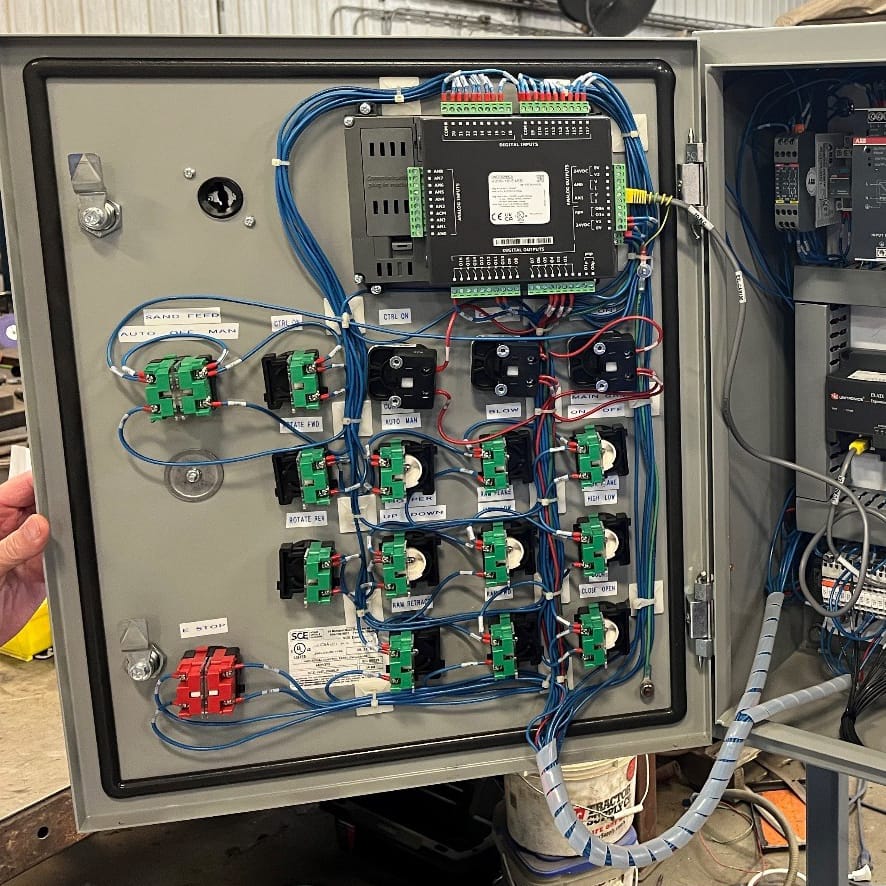
ACS engineered and built the full package: all eight panels, wired as far as they could be before shipment, with the structural steel and mounting fabricated to match each substation’s design. The field engineer’s job on site changes from building the panels to connecting to them.
The work was built around how this customer actually operates and maintains his system:
Engineered to his components, not ours.
He didn’t want the standard SEL relays on the reclosers. He wanted Eaton. ACS laid out and designed the panels around the components he specified, along with the test switches, wiring access, and protection he preferred, because he’s the one who has to maintain the system going forward.
Pre-wired for what comes later.
Some components will be populated at a future date. Rather than leave that work for the field, ACS wired those circuits in place now, so when the relays arrive he sets them in and connects, with no wiring from scratch.
Delivered as a complete package.
ACS designed and fabricated all the structural steel, the mounting and the framework that holds the panels in the substation building, and is delivering it with the panels, plus support through installation. One package, one point of coordination.
This is the difference between build-to-drawing and engineering. Getting there took months of back-and-forth to work through the design (component choices, access, protection, structure) until the panels matched the way the co-op runs its substations.
The Numbers
- Eight panels off the field engineer’s bench. Instead of wiring eight panels from scratch on site, he connects to finished, pre-wired assemblies, the difference between one person’s throughput and a shop’s.
- One vendor instead of several. Panels, custom structural steel, and install support delivered as a single package, rather than sourcing parts, fabrication, and labor separately.
- Transparent, component-cost pricing. This is a technical buyer who has purchased these parts himself and knows what they cost. Pricing was built up from real component cost plus the engineering and build labor, not priced to what the market would bear, and it held up to a line-by-line review.
Panels are now in fabrication; field performance data will follow as the substations come online.
The Result
ACS secured the order and the panels are in production. Just as important, the collaboration cleared the co-op’s core constraint: its field engineer no longer has to build eight panels by hand to hit a schedule he couldn’t have hit alone. He directs the design, ACS executes the engineering and the build, and he’s freed to focus on getting two substations connected and commissioned on time.
For a first-time customer, introduced through one of ACS’s supply partners and developed over the better part of a year, the project is a working example of what ACS does for smaller utilities: absorb the engineering and fabrication burden without taking the technical control away from the person who has to live with the result.
Why ACS
For utilities and co-ops that need more than a panel off a drawing, ACS brings:
- Real design engineering, not build-to-drawing. ACS helps define and refine the panel (layout, access, protection, structure) around the customer’s requirements and the way they maintain their system.
- Component flexibility. Prefer Eaton over SEL, a specific test switch, a particular protection scheme? ACS engineers to the components the customer specifies rather than forcing a standard.
- Change-ready, collaborative engineering. Months of iteration to get the design right, with the customer directing and ACS advising. Not a take-it-or-leave-it product.
- Structural and electrical under one roof. Custom steel, mounting, wiring, and install support delivered as a single, coordinated package.
- Pricing a technical buyer can verify. Built up from real component cost and engineering value, transparent enough to survive a knowledgeable customer’s scrutiny.
Start an Engineering Conversation. If you’re planning a substation build or upgrade and need control panels engineered to your spec, and delivered ready to connect, talk to an ACS engineer.
©2026 Appleton Control Systems
